
Claude
Why Claude is my primary AI platform
I work across multiple AI models — ChatGPT, Gemini, and others all have their place. But Claude, built by Anthropic, is the one I keep coming back to. It handles nuance better than anything else I've used. It follows complex instructions without drifting. And when I'm working on something that requires sustained reasoning across a long piece of strategy, research, or writing, Claude consistently produces work that I'd be comfortable putting in front of a client or a board.
This page is a window into how I use Claude — from building tools and websites to designing projects and doing the strategic thinking that underpins everything else.
Claude Code: the CMO who builds
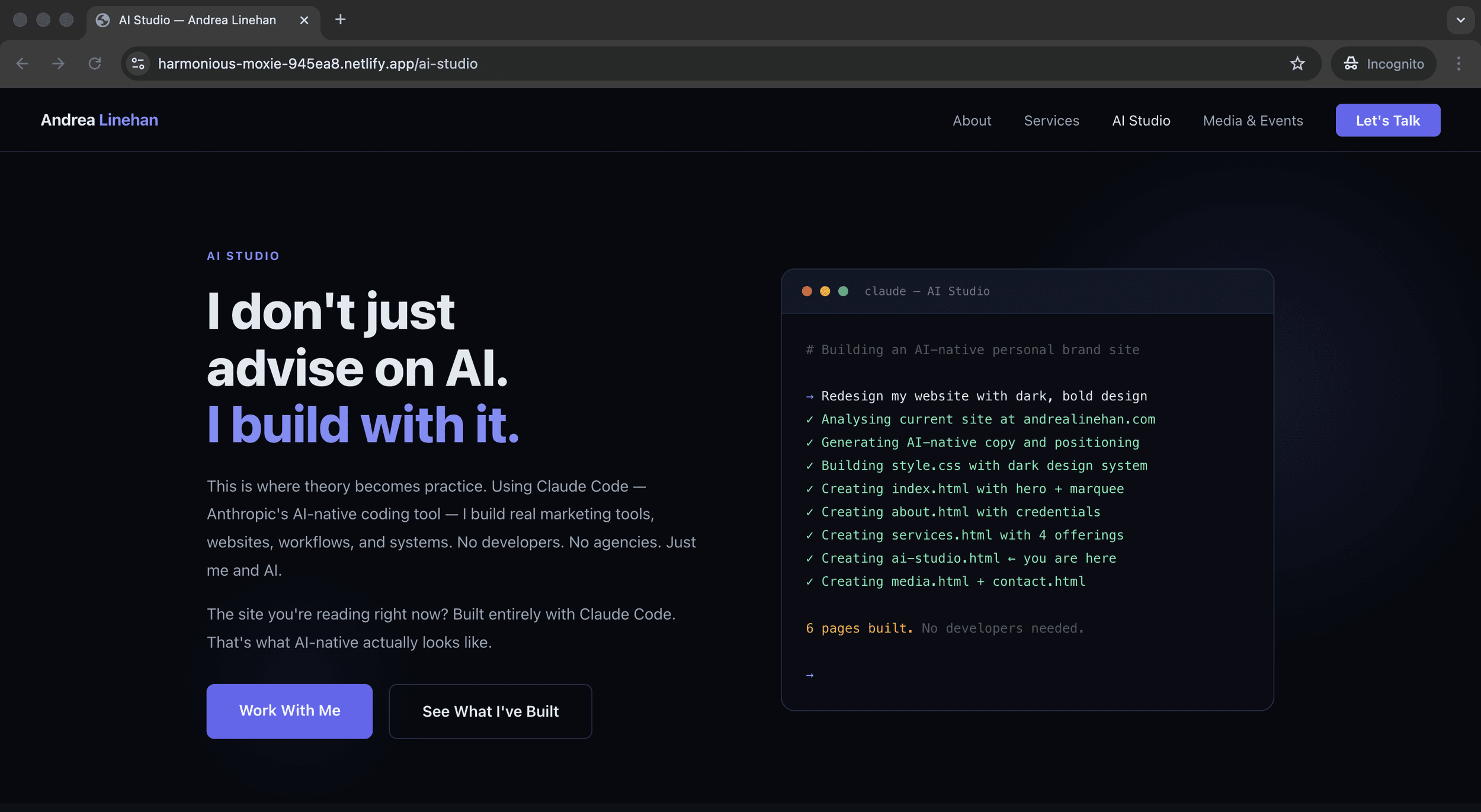
I'm using Claude Code to rebuild my website from scratch. Not because I needed a new website. Because I wanted to prove that non-technical marketers can build functional, professional digital products with AI coding tools.
The result is a live Netlify site that I designed, prompted, and iterated entirely through Claude Code. No developer.
What I've built with Claude Code
This website (in progress). Every page is being rebuilt using Claude Code. It's not perfect — and I'm honest about that — but it's close, and the speed of iteration is extraordinary. Changes that would have taken a developer days take me hours.
Prototypes and proof-of-concepts. When I'm working with a client and want to show them what's possible before committing engineering resources, I build a working prototype with Claude Code. A landing page concept. A dashboard mockup. A tool that demonstrates a workflow. It shifts the conversation from "imagine if we could..." to "here — try this."
Internal tools. Simple utilities that make my own work faster: data formatters, content templates, analysis frameworks. Small things that save time every day.
Why this matters for a CMO
This isn't about becoming a developer. It's about removing the bottleneck between an idea and a working version of that idea. The ability to prototype, test, and demonstrate without waiting for a dev team changes the speed at which marketing can move. When I work with clients, I can show them what I mean rather than just describing it. That's a different kind of conversation entirely.
Claude Projects: bespoke AI assistants
Claude Projects allow you to create persistent AI workspaces with custom instructions, uploaded documents, and specific knowledge bases. I use them to build focused assistants — for my own practice and for clients.
How I use Claude Projects
Strategy workspaces. For each client engagement, I create a Claude Project loaded with their brand guidelines, competitive landscape, market data, and strategic objectives. When I'm working on their account, Claude already has the context. I don't start from zero each session. The result is faster, more consistent strategic output that builds on previous conversations rather than repeating them.
Content and brand voice assistants. I build Projects trained on a client's tone of voice, existing content, and messaging framework. The assistant can then generate on-brand drafts, review content for consistency, and suggest messaging alternatives — all grounded in what the brand actually sounds like, not a generic approximation.
Research and analysis hubs. For complex projects — market entry analysis, competitive positioning, investor materials — I create a dedicated Project that holds all the source material. Claude can then synthesise across dozens of documents, surface connections I might miss, and stress-test arguments before they go into a final deliverable.
What I'm building next
I'm expanding my use of Claude Projects that holds the strategy, understands the brand, and can help the execution day-to-day - an intelligent assistant that keeps the strategy alive.
Claude for strategic thinking
Beyond building tools and projects, Claude is embedded in how I think through problems. This is the less visible but arguably most valuable part of my Claude use.
Competitive analysis. I use Claude to rapidly analyse competitor positioning, messaging, and go-to-market approaches. Upload a competitor's website, their recent press, their job postings, and Claude can surface patterns and strategic signals that would take hours to identify manually.
Scenario modelling. When I'm developing a go-to-market strategy, I use Claude to stress-test assumptions. "What happens if our conversion rate is 20% lower than expected? What if the competitor launches three months early? What if we need to cut the budget by a third?" These conversations sharpen the strategy.
Board and investor preparation. I use Claude to pressure-test pitch narratives, anticipate tough questions, and refine the financial story around marketing investments. For founders preparing to raise, this is particularly valuable — Claude can simulate an investor Q&A in ways that reveal blind spots before the real meeting.
Writing and editorial. Every long-form article I publish goes through Claude. Not for the first draft — the thinking is mine — but for structural editing, argument stress-testing, and catching the weak points I'm too close to see. It's the most rigorous editor I've worked with, and it doesn't have an ego.
Claude versus ChatGPT: when I use which
People often ask why I use both platforms. The short answer is that they're good at different things, and being model-agnostic means I get the best result for each task.
I reach for Claude when: the work requires sustained reasoning across long documents, precise instruction-following, nuanced writing, complex analysis, or code generation. Claude handles ambiguity and complexity with less drift than any model I've tested. For strategy work, projects, and anything that needs to hold a consistent thread across a long conversation, Claude is my default.
I reach for ChatGPT when: I need to build Custom GPTs for the GPT Store (Claude doesn't have an equivalent public marketplace yet), when I want image generation integrated into the conversation, or when I need access to specific plugins or integrations that OpenAI's ecosystem supports. The Custom GPTs I've published are on ChatGPT because that's where the distribution is.
I reach for Gemini when: I need deep integration with Google's ecosystem — Search Console data, Google Ads insights, or analysis that benefits from Google's real-time web access.
The model wars make good headlines. In practice, the CMO who gets the best results is the one who knows which tool to pick for which job.